

Anyway, to make Tteok-cha, I picked the tea leaves, which were only on top of tea branches.
The cute kitty, "Yomy" was waiting for me to be petted. :)

After tea picking, we steamed the tea leaves until they become soft, and started pounding in a traditional stone mortar.

Pounding, and pounding.

And more pounding until they become like a rice cake. It was funny that because of pectin in tea leaves, more I pounded them, they became gummy, or rice cakish. :)

Here, super green tea ball!!!

And then, we divided them into small pieces and kneaded them a bit more.

Compress them into this pretty tea cake mold. Press it as hard as you can!!

Voila!!!

Yummy looking little stuffs!!!
If it was a spring or summer day, I could dry them outside. However, if the sun is not enough, it's better dry with food dryer. Otherwise they will become moldy.

Once they dry, tie and hang them somewhere dry.

The older, the better.
Wait as long as you can!!
Here's the information about Tteok-cha from "Tsiosophy".
http://www.tsiosophy.com/2012/04/report-on-the-2012-korean-tea-exhibition-tteok-cha/
Tteok-cha 떡차 is an ancient form of tea, the leaves usually steamed, pounded, and compressed into a small cake. Caked tea was first recorded in China as bingcha 餅茶 during the Three Kingdoms period, circa third century A.D. Then as now, the making of caked tea was time consuming, labor intensive, and expensive. Given its cost and rarity, tteok-cha was prepared and served with regard and ceremony as part of high etiquette, and the drinking of the brew was considered special. In Korea, caked tea was once called byeong-cha 병차 and was likely introduced during the Samguk era before 500 A.D. as a precious import to the peninsula from the continent.
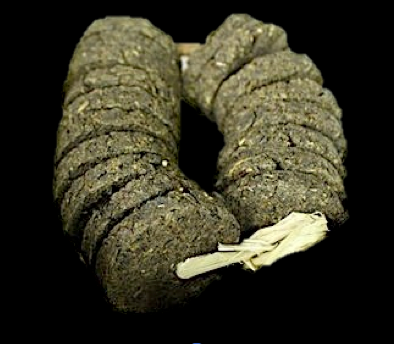
Tteok-cha strung on a cord
The many parallels between caked tea and rice cake are striking. Caked tea is not only similar to the making of rice cake but it is also alike in shape, the pieces resembling flat, thick disks the size of a large coin. Indeed, during the Joseon dynasty, tteok-cha was also known as jeon-cha 전차 or jeon-da 전다, “coin” tea. And like the various forms of rice cake made for special occasions, caked tea comes in many different shapes, including rounds, squares, rectangles, pentagonals, hexagonals, octagonals, flowers, and even buns and cones.
HS


